Patrick Sumner
The North WaterPatrick Sumner is a former army surgeon whose passage from military disgrace to Arctic whaling makes him both a skilled observer and a man repeatedly forced into circumstances beyond his control. A limp, a dependence on laudanum, and a history of bereavement and humiliation accompany him aboard the Volunteer; there, physical labor, the death of Joseph Hannah, and a dangerous commercial conspiracy test the distance between professional identity and actual power. Sumner’s significance lies in that tension: he can diagnose a body, but cannot restore the dead, and his survival repeatedly requires action rather than the certainty of a settled moral or social position.
Identity and Background
Sumner joins the Volunteer as its surgeon after experiences in the British Army and the Punjab. He is from Castlebar, is short and narrow-featured, and walks with an unfortunate limp. Arthur Brownlee, drawing on thirty years of judging people from the quarterdeck, initially finds him an awkward and difficult case. Yet Brownlee is also drawn to Sumner’s capacity not to ingratiate himself, and sees in that independence something of his own younger self. The captain’s guarded approval establishes Sumner as a person whose apparent disadvantages do not determine his usefulness or character.
His past is marked by losses and reversals. Sumner remembers the deaths of his parents from typhus and of William Harper from drink, as well as betrayal, humiliation, poverty, disgrace, and plans that failed or were abandoned. His military career ended in disgrace, and he has arrived at sea with little to show for his former ambitions. He reflects that being reduced to almost nothing may also mean being at liberty: if the worst has already happened and he remains alive, then his uncertain condition might be understood not only as defeat but as a form of freedom. That thought does not resolve his fear, but it gives his continued survival a possibility beyond mere endurance.
Work and Life Aboard the Volunteer
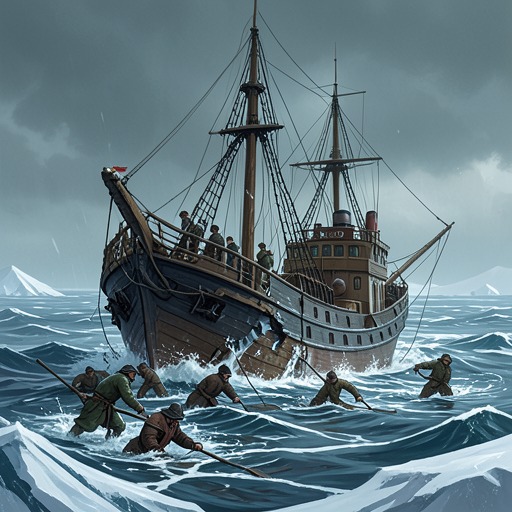
The voyage north begins in sustained discomfort. Sailing from Lerwick through fog, sleet, and bitter wind, the ship is twice struck by gales. Sumner remains in his cabin, vomiting and unable to read or write, and wonders what he has done by joining the expedition. On the eleventh day, the weather eases and the crew reaches sea ice near Jan Mayen Island. The change of conditions brings the men out onto the ice to hunt seals, but Sumner’s early experience of the Arctic remains one of bodily vulnerability and dependence on the ship’s movements.
Whaling soon puts his body to work in ways his medical title does not predict. After two more whales are killed and flensed, Sumner is assigned a pick haak and a long leather apron. He carries blocks of blubber, each weighing twenty pounds or more, from the foredeck and pitches them down to the men in the hold. The labor is dirty and exhausting; he slips several times and nearly falls into the hold before Otto saves him. Yet he ends the day bruised and aching with an unusual sense of satisfaction: the work has tested his body and proved it capable. That night, for once, he sleeps without laudanum. The episode makes physical effort a counterpoint to the helplessness and self-doubt that otherwise shape his experience.
The economics behind this labor are increasingly precarious. A whale brought alongside is estimated by Brownlee to yield ten tons of oil and more than half a ton of whalebone, worth nearly nine hundred pounds if market prices hold. But Baxter tells Brownlee that the old, comparatively accessible profits have vanished: whale oil is losing its market to petroleum and coal gas, while modern whaling requires expensive engines, harpoon guns, and luck. Sumner is not shown taking part in that discussion, but the contrast frames the hazardous industry in which he has enlisted: strenuous work and the killing of animals no longer guarantee a profitable return.
The Ice, the Bear Cub, and Bodily Vulnerability
Sumner’s limp is not merely an introductory description; it shapes how he negotiates the ice. At a gap between floes, he uses the method experience has taught him—taking off from his bad leg and landing on his good one. In falling snow, however, his standing foot slips and he pitches into the black water. The fall turns a practical adaptation to disability into a point of acute exposure: the same body that has managed demanding shipboard work can still be defeated by shifting terrain. The incident also locates his vulnerability in the physical environment, not simply in an individual failing.
Later, after entering Lancaster Sound, Sumner regularly gathers scraps from the galley to feed the captured bear cub kept in a cask. He pushes food through the grille with a large metal spoon, frees it when the cub bites down on it, and gives the animal more food and water. The small routine is an instance of care within an expedition otherwise governed by hunting, confinement, and work. It also makes Sumner’s relation to animals more complicated than the ship’s commercial use of them: he tends a captive creature even as the voyage depends on killing and processing wildlife.
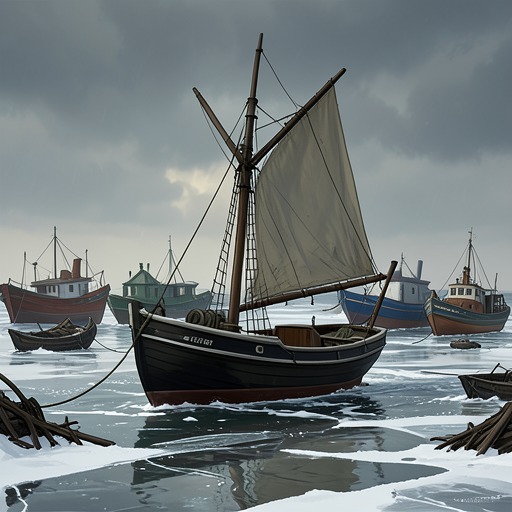
When drift ice begins moving toward the ship, Cavendish orders the crew to cut an ice dock for protection. Sumner is part of a company whose survival depends on collective labor and rapid response to changing conditions. The scene echoes the earlier blubber work: on the ship and on the floe alike, survival is practical, shared, and physically demanding, rather than secured by rank or professional title.
Joseph Hannah’s Death and the Limits of Medicine
Sumner’s medical role becomes most painful when Joseph Hannah first comes to him complaining of a foul stomach. Later, the crew carries Hannah’s body to the mess cabin and lays it on the table for examination. The gathered men look to Sumner because he is a surgeon, but he recognizes that the title cannot answer what they want from him. He cannot bring the boy back to life. He examines Hannah’s chin and notes the dark chain of bruises around the neck, confronting the visible evidence of death rather than a condition he can treat.
The death continues to trouble him after the crew settles on McKendrick’s guilt. Even with laudanum, Sumner sleeps only in short stretches. He remembers Hannah’s body on the varnished tabletop where the crew still eats dinner, and McKendrick standing naked and exposed in the captain’s cabin. Sumner cannot make the two scenes fit together as proof of a coherent account. His inability to accept the crew’s conclusion is not presented as a solved investigation; it is a refusal to treat collective certainty as a substitute for evidence. Hannah’s death thus changes the terms of Sumner’s position aboard ship: he is no longer merely the surgeon who failed to save a patient, but a witness unsettled by the explanation offered for the boy’s death.
Relationships, Conspiracy, and Later Movements
Sumner’s relationships are shaped by the mismatch between what others need him to be and what he can actually do. Brownlee sees promise in him despite his awkwardness. Otto’s intervention when Sumner nearly falls into the hold is a concrete act of assistance amid dangerous labor. By contrast, the crew’s expectations after Hannah’s death expose the limits of Sumner’s authority: the surgeon is asked to make sense of a death, but the men prefer the reassurance of an established suspect.
His later account of the Volunteer’s loss shows him interpreting events as part of a deliberate insurance scheme. He tells Baxter that Cavendish was to sink the ship, while Drax and Sumner were the only men who might know or suspect what had happened. In the sequence Sumner describes, Drax would shoot him and Stevens would then shoot Drax, leaving an apparently neat outcome; Sumner says that the plan misfired. Campbell’s warning that the ship had to be sunk in a way that would not alert the underwriters, and Drax’s statement that he could sink her later if necessary, give this suspicion a concrete commercial context. The evidence establishes Sumner’s understanding of the scheme and its intended cover, not every detail of how the plan was carried out.
After his time at sea, Sumner reaches a quayside where Stevens, described as Baxter’s man, is waiting. Sumner packs his few belongings, says farewell to Captain Crawford and the crew of the Truelove, and walks with Stevens toward Baxter’s chambers on Bowlalley Lane. The firm geometry of streets and buildings feels unreal to him after weeks at sea. Later, he travels on horseback through Driffield and Gorton, reaches Pickering after nightfall, and gives the name Peter Batchelor when asked who he is. The assumed name and his continuing movement suggest a man still negotiating the consequences of his past, rather than returning to a settled identity. His arc remains deliberately uneasy: survival has carried him beyond the ship, but neither safety nor a final resolution follows automatically from being alive.